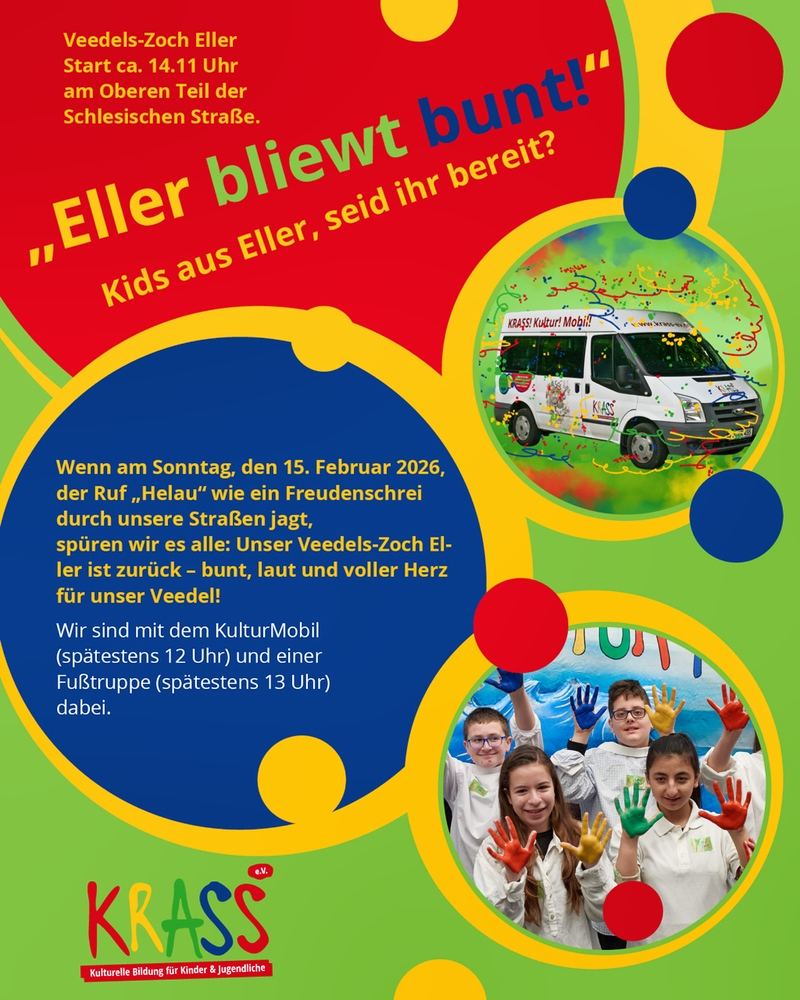
Hello dear children and young people in Eller! We can hardly wait: On Sunday, February 15, 2026, the neighborhood carnival parade will wind its way through our streets in our shared neighborhood. And KRASS e.V. will of course be there!
Under the motto "Eller bliewt bunt“Let’s celebrate Carnival together with you and the whole neighborhood. We’re celebrating what unites us: joy of life, creativity, community, and lots of color. That’s exactly what our club stands for. That’s why we’re so excited to be part of this special day.”
KRASS on the move at carnival for children with culture and lots of color
We'll be there for you early on Sunday:
With our KulturMobil, we will be on site from 13 p.m. at the upper part of Schlesische Straße (between Schweidnitzer Straße and Breslauer Straße)
And then the real fun begins!
Then, at 14:11 p.m., the parade starts in the upper part of Schlesische Straße – between Schweidnitzer Straße and Breslauer Straße – when we set off, our disguised CRAZY ArtistsArtists, children, and parents all right in the middle of it, loud, cheerful, and with tons of awesome energy. Then, "Helau“Like a shout of joy echoing through all of Eller, we feel it anew every year: Carnival means togetherness. It's a festival by Eller for Eller! And this sense of community is especially important to all of us. Everyone comes together, everyone celebrates!”
Come by – we look forward to seeing you!
Good to know: The little carnival dictionary for all newcomers, curious minds, and tomorrow's revelers.
Jecken
In the Rhineland, people who celebrate Carnival are called "Jecken." This term refers to everyone who enjoys dressing up, MusicIt's about laughter and good cheer. Being a reveler doesn't mean being crazy, but rather open, cheerful, and a little playful. During Carnival, everyone is equal – whether big or small, old or young. Anyone who joins in the fun, laughs, or simply enjoys watching is already part of it.
Helau
"Helau" is one of the most well-known carnival cries – especially in Düsseldorf and many other carnival regions. It's a greeting used to express joy and a festive mood. When someone shouts "Helau," it means something like: "It's great that you're here – let's celebrate!" No one really knows the exact origin of the word. It likely comes from very old dialects and used to mean something like "Hello," "Attention," or "Here we go!" Today, "Helau" primarily stands for one thing: celebrating together and having fun.
Karneval
Karneval (Carnival) is a large and joyful celebration that is celebrated every year in many regions before the beginning of Lent. People dress up in costumes, listen to music, dance, sing, and celebrate together in the streets. For a few days, everyday life moves into the background and shared experiences take center stage.
The roots of Carnival stretch back many centuries. Over time, various customs developed, which later became associated with the Christian season of Lent. In earlier times, Carnival was a period of revelry, celebration, and gathering before the start of Lent.
Today, Carnival is primarily about community, joy, and experiencing special moments together. It's a time when people come together – regardless of their age or where they come from.
Eller bliewt bunt
"Bliewt" is a Rhenish dialect word meaning "stays" or "remains" in standard German. In the motto "Eller bliewt bunt" (Eller remains colorful), this means: Eller remains diverse, vibrant, and open. It implies that the district should stay as many people know and appreciate it, with its different cultures, ideas, and colors.
Zoch
A "Zoch" is a carnival parade. Groups of people, dressed in costumes and accompanied by music, walk through the streets together. Some groups walk, others ride on decorated floats. From the parade route, sweets are thrown into the crowd. People on the sidelines wave, shout "Helau," and join in the celebration. A Zoch is loud, colorful, and full of life.
Kamelle
"Kamelle" are the sweets thrown into the crowd during the carnival parade. These include things like hard candies, chocolate, or small gummy bears. As the parade passes by, many people shout "Kamelle!" to indicate that they would like to catch some. Collecting sweets is a real highlight of carnival, especially for children. The term "Kamelle" originates from the Rhineland and was formerly used primarily for hard candies or caramels. Today, it generally refers to all the sweets that are handed out during carnival.
Veedel
"Veedel" is a word from the Rhineland dialect and means district or neighborhood. When someone says "Ein Zoch von Eller für Eller" (A parade from Eller for Eller), it means that people from the district are celebrating together for their own neighborhood. The Veedel represents closeness, community spirit, and the feeling of being at home. People know each other and stick together.
Biwak
A Biwak is a meeting place before or during the carnival parade. Think of it like a small street festival. There's music, often dancing, food, and drinks. Most importantly, it's a place for people to meet, chat, laugh together, and get in the mood for the parade. A bivouac is open to everyone and a wonderful place to experience carnival together.
Prinzenpaar
In many carnival cities, the Prince and Princess are an integral part of the festivities. They are special representatives of the carnival season, attending numerous events, participating in parades, and spreading cheer. In some places, instead of a Prince and Princess, there are other carnival figures or traditions. They symbolically represent the joy and spirit of carnival.