"In the beginning we sat there and no child came"
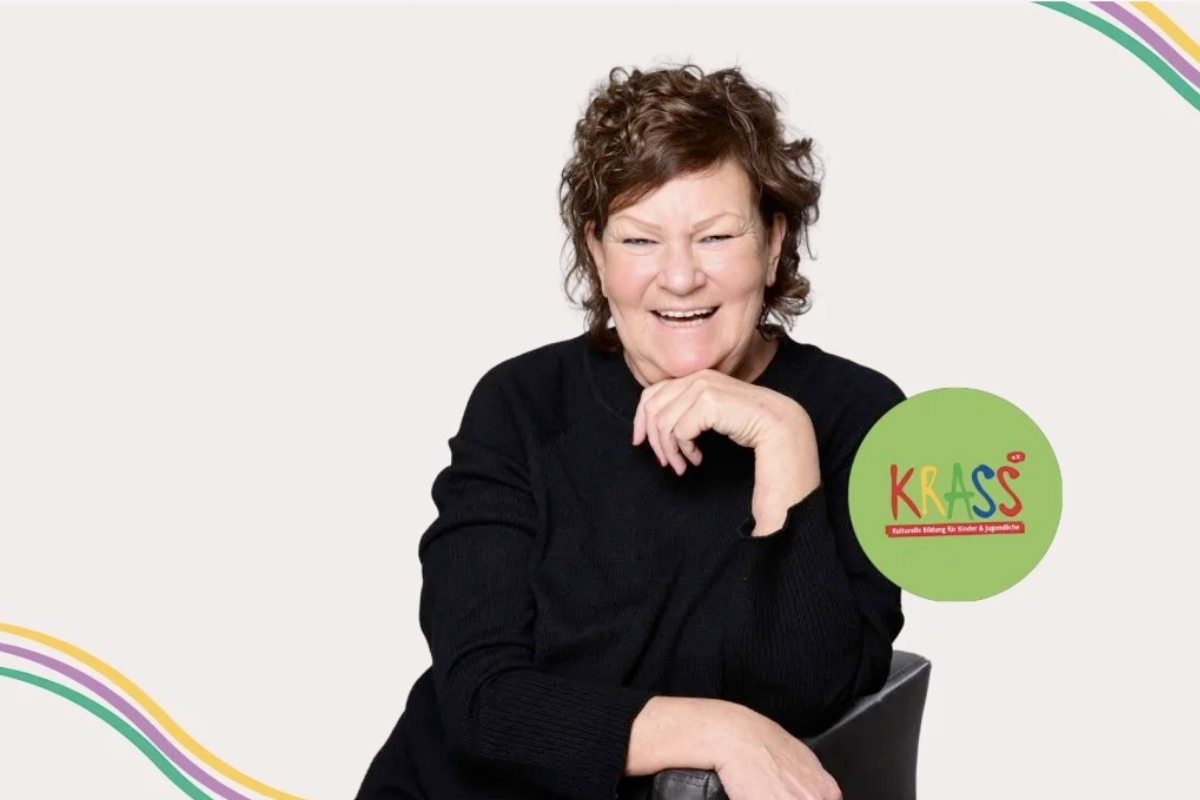
In an interview with MINTvernetzt, Claudia Seidensticker spoke about the founding and development of KRASS, a creative educational project for children and young people.
The idea for KRASS emerged in 2005 after a severe traffic accident forced Claudia Seidensticker to reorient her life. Inspired by her passion for arts education and working with children, she initially founded a work with children, she founded a children’s studio. To attract attention, she opted for a spectacular launch right away: by setting up the world’s largest children’s studio, she succeeded in achieving a world record, thereby securing both media attention and funding.
Success through a "mobile approach"
However, success in the studio was not enough to reach children. Seidensticker quickly realized that the target group would not simply come to her. The solution was a mobile approach: a bus equipped with painting materials brought the activities directly to where children and young people spent their afternoons. They were supported by street workers who identified locations and helped facilitate initial contact.
Formats for children and young people
KRASS offers different formats for various age groups. While younger children are often found in playgrounds, teenagers require creative ways to reach them. These include, for example, mobile recording studios at sports fields or backyards. Long-term relationships are essential for Seidensticker, as only continuous programs give children the opportunity to develop their ideas and feelings and find their own voice.
Break down barriers, awaken curiosity
The approach to reaching educationally disadvantaged children deliberately differs from that used with children from more privileged backgrounds. Mobile, eye-catching buses help lower barriers and spark curiosity. In total, KRASS implements around 18 educational projects, supported by a team of full-time professionals and volunteers. A particularly important principle for Seidensticker is that artists are paid for their work. In this way, children learn from professionals and experience artistic professions up close, while diversity and professional quality are ensured at the same time.
Participation, team spirit, tolerance
For Claudia Seidensticker, cultural education is not just a creative offering, but a crucial building block for social participation. It strengthens team spirit, tolerance, a sense of responsibility, and the ability to think critically. KRASS measures the success of these programs using a so-called “impact staircase”: from initial participation to individual scholarships, progress is made visible – one example is a girl who, through KRASS, went on to become a successful graphic design student.
KRASS thus demonstrates how art and culture can support children and young people, open up new perspectives, and enable social participation – and that creative educational work is particularly effective when it is designed to be sustainable, professional, and diverse.
Here you can see the whole Read the interview.